Looking for dependable Mississauga windshield repair? Go with experts who put first safety: fast chip/crack evaluation, ANSI‑compliant resins, calibrated vacuum injectors, and UV curing that brings back clarity and ensures proper airbag deployment. Expect mobile service in about 60 minutes, OEM‑approved materials, ADAS‑safe methods, photo documentation, and a lifetime workmanship warranty. The team will help with insurance claims, provide clear pricing, and inform you when replacement is essential for edge or long cracks. You'll receive aftercare advice and calibration guidance-you'll find more that can help you choose confidently.
Main Points
- Choose AGSC/NWRA-certified technicians with verified training, batch-traceable resins, and calibrated UV equipment for reliable, standards-compliant repairs.
- Focus on shops that provide ADAS-safe practices and on-site calibration or verified referral calibration once completed windshield work.
- Check for clear repair vs replacement criteria, same-day assessments, and mobile service with a specified 60-minute workflow and drive-away guidance.
- Confirm written warranties, insurance billing assistance, and transparent pricing before service begins.
- Confirm pre- and post-repair images, moisture removal, vacuum-cycling resin injection, and recorded cure times for quality assurance.
The Importance of Prompt Windshield Repair for Visibility and Safety
Because a windshield is a critical safety component, postponing repairs undermines both structural integrity and visibility. You rely on the laminated glass to copyright cabin rigidity, support appropriate airbag deployment, and prevent roof collapse in a rollover. Even slight damage can scatter light, create visibility hazards, and intensify glare, extending your reaction time. Temperature variations, road vibrations, and moisture intrusion can propagate flaws, increasing failure risk exactly when you need clear sightlines.
Act without delay to restore windshield transparency and load-bearing strength. You'll reduce driver fatigue, increase wiper performance, and keep advanced driver-assistance sensors calibrated within specification. If damage impairs your forward view or edges, follow emergency protocols: avoid high-speed movement, increase following distance, and schedule professional repair as soon as possible. Immediate service protects you, passengers, and every road user.
Chip Compared to Crack: Understanding Damage Types and Fix Options
You should identify the difference between a chip-localized impact with a small pit or bull's-eye-from a crack, which is a linear fracture that can spread. We'll examine crack severity by length, location, and propagation risk, since anything near edges, longer than 6 inches, or in the driver's critical view demands urgent attention. Depending on the assessment, our recommendation includes resin repair for stable chips and minor short cracks, or full replacement when structural integrity or visibility is compromised.
Spotting Chip Damage
Identify the distinction quickly to safeguard both visibility and structural soundness. To detect chip damage, examine for a localized impact point with a minor pit and ring-shaped fracture rings. Chips are typically under a quarter across and won't display linear propagation. You may notice minute radial marks, but they stay short and clustered around the pit. Inspect for optical distortion when light transmits through; chips generate a localized blur not a line. Inspect edge patterning-uniform, rounded fractures suggest a chip, not a spreading defect.
Move a fingertip across the region; a chip resembles a shallow depression, not a raised ridge. Mark placement: chips around the driver's sightline or close to the glass edge demand priority. Quick professional resin injection restores strength and stops contamination.
Severity Classifications for Cracks
While both begin as impact damage, cracks vary from chips by length, direction, and risk, and they require faster decisions. You'll see three severity levels. Hairline fractures are short, surface-level lines under 6 inches; they're stable if away from edges and sensors, and a quick resin injection usually restores strength. Medium cracks (6-12 inches) exhibit branching or curvature, often from stress concentration near edges or temperature swings; repair is feasible if they're clean, dry, and outside the driver's primary viewing area. Long cracks (over 12 inches), edge cracks, or cracks intersecting previous repairs undermine structural integrity and generally require full replacement. Act swiftly: contamination and vibration let cracks expand. Photograph the damage, avoid car washes, shade the glass, and schedule a same-day assessment.
How Professional Resins and Equipment Restore Structural Integrity
When your windshield suffers a crack, precision tools and professional resins restore its structural capacity by bonding the cracked glass layers into a single stress-dispersing system. You benefit from advanced resin chemistry suited to the crack type and glass interlayer, delivering appropriate viscosity, capillary action, and modulus after curing. Vacuum-cycle injection systems extract air and moisture, then introduce resin under regulated pressure to eliminate voids that would concentrate stress.
Exact tool calibration is critical. Technicians verify injector seals, pressure ranges, UV lamp intensity, and cure times to achieve complete polymerization without over-shrinking. They condition the glass temperature for optimal wetting and alignment, then finish with pit-filling and polishing to preserve the repair. The result: renewed clarity, increased impact resistance, and a structurally sound windshield you can trust.
When Repairs Can Be Done-and When Replacement Is the Answer
Safe repair is possible for small chips and short cracks that sit outside the driver's primary viewing area and remain away from the edges or penetrated the laminate. It's necessary to have a full replacement if the crack is lengthy, reaches the perimeter, distorts your view, or shows spreading, moisture intrusion, or internal contamination. We evaluate size, location, and structural risk to recommend the most cost‑effective and safest option.
Compatible Damage Types
Let's begin with the fundamentals: not every windshield flaw necessitates a full replacement. You can safely repair tiny chips (bullseye, star, or combination) and short cracks when they're shallow, stable, and outside the driver's primary viewing area. Typical repairable sizes are chips up to a quarter in diameter and cracks under 6 inches, provided there's no moisture intrusion or contamination.
Stone pitting is usually cosmetic; if pits don't concentrate or reduce clarity, a surface polish or resin fill restores visibility. Edge delamination-where the laminate separates near the perimeter-requires careful assessment; limited, confined areas without crack propagation can sometimes be stabilized. Quality repairs require clean impact points, intact inner laminate, and no spreading stress lines. We pressure-test, vacuum-cycle, and UV-cure resins to restore structural strength and optical integrity.
Warning Signs Requiring Replacement
While various damages are eligible for safe repair, some warning signs suggest complete windshield replacement protects you best. You need replacement when cracks exceed safety thresholds (generally over 6 inches), intersect the edge, or branch in multiple directions. You must replace if damage encroaches upon the driver's critical viewing area, distorts optics, or impacts embedded sensors, cameras, or heating elements. Any delamination, white haze at the perimeter, or water infiltration suggests the laminate bond is failing.
Follow legal requirements: chips or cracks impeding the sweep of the driver's wipers, or impairing ADAS calibration, can make your vehicle noncompliant. If prior repairs radiate new cracks, or impact points are damaged or contaminated, don't risk repair. After collisions, airbag deployment, or structural flex, opt for replacement to restore cabin integrity and visibility.
What Happens During a 60-Minute Mobile Service Visit
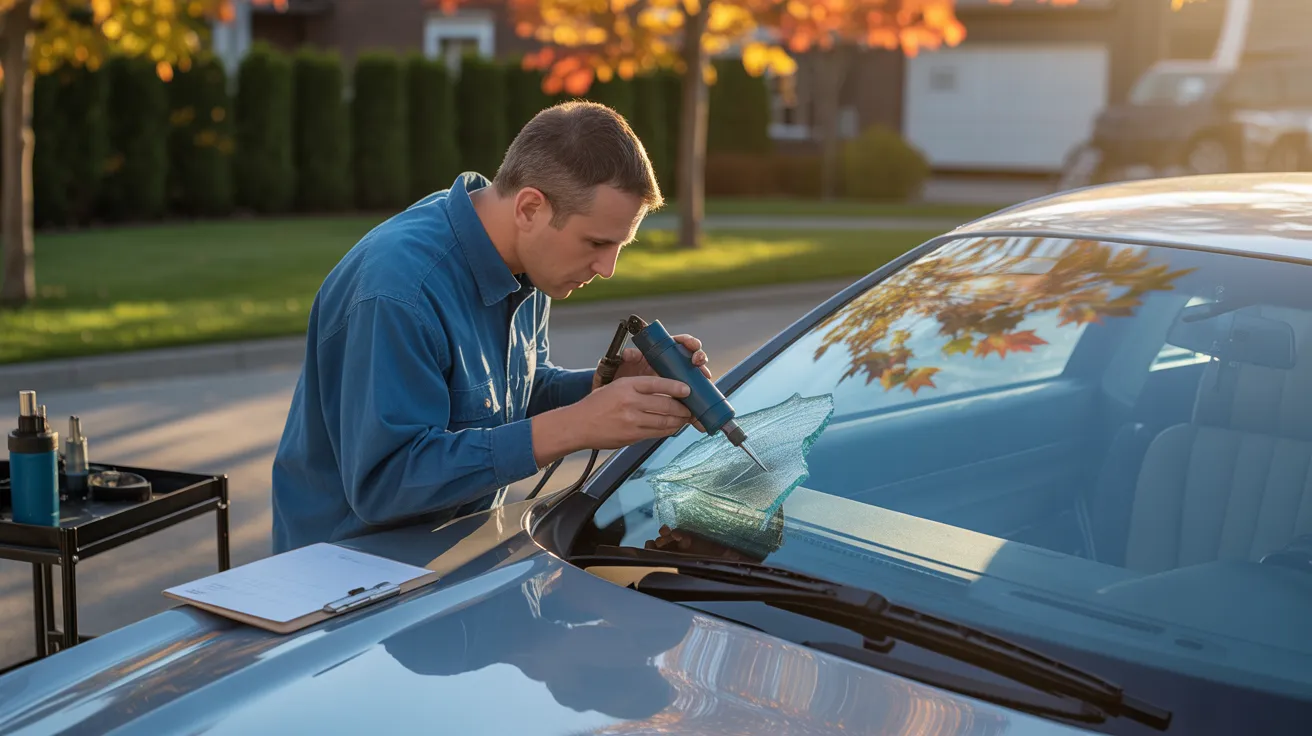
Before the clock starts, a qualified technician reaches your location, confirms vehicle details, and performs a safety-focused inspection to confirm repairability. They follow a defined arrival protocol: set up the work zone, examine damage, and run mobile diagnostics to determine crack length, impact points, and sensor proximity. You'll receive a clear scope, price, and estimated cure time before any work begins.
Time 0-15: Protect inside/outside, wipe glass, and mount a stabilizer.
Minutes 15-35: Extract atmospheric contaminants, introduce OEM-specification resin corresponding to crack type, and then pressure-cycle to remove micro-bubbles.
Time 35-50: UV-cure resin, layer as needed, and cure again for maintaining structural stability.
Minutes 50-60: Polish for crystal-clear clarity, clean off, and complete ADAS-safe visibility assessments. We'll give you maintenance guidance, safe driving recommendations, and a comprehensive service report.
Certifications, Training, and Standards to Look For
When evaluating a windshield repair service provider, check for third-party credentials that establish competency and safety compliance. Seek out industry certifications such as I-CAR, NWRA/AGSC, or OEM-specific approvals that certify processes, materials, and calibration practices. Confirm that the shop follows AGSC/ANSI standards for resin selection, curing standards, and crack-stop procedures.
Ensure technician training is recent and well-documented. You should see proof of initial coursework plus annual refreshers that cover glass identification, damage assessment limits, moisture control, UV curing, and ADAS camera-safe procedures. Confirm torque specs and primer dwell times are uniform and documented on work orders.
Confirm that shops work with calibrated UV lamps, verifiable batch-number resins, and clean-room handling for sensor areas. Demand pre- and post-repair inspections with pictures, lot
Transparent Pricing, Insurance Management, and Warranties
You should expect clear, upfront pricing that itemizes materials, labor, and any OEM-spec parts before work commences. We process insurance claims end-to-end-confirming coverage, submitting documentation, and coordinating approvals-so your safety-critical repair stays on schedule. We provide a lifetime workmanship warranty that covers leaks, wind noise, and adhesion failures under normal use.
Clear, Upfront Pricing
Curious about what a windshield repair will cost and cover? You'll get clear, upfront estimates check here before any work begins, so you can approve pricing with confidence. We evaluate chip size, crack length, impact zone, and sensor proximity to determine the correct procedure and parts. When scope is standardized, we use flat rates; if variables affect safety or calibration, we detail labor, materials, and any ADAS considerations.
We clarify what's included: manufacturer-approved resins, UV curing, moisture purge, surface preparation, and post-repair inspection. You'll never encounter hidden shop fees or surprise add-ons. If a repair isn't structurally safe, we tell you immediately and provide a exact replacement quote. Every invoice includes line items and warranty terms, so you know exactly what you're paying for—and why it keeps you safe.
Hassle-Free Insurance Claim Management
Although filing a claim might appear complex, we make insurance uncomplicated, open, and secure from the very start. You'll receive detailed cost breakdowns before we start, compatible with your policy's glass coverage. Our advisors handle claims coordination end-to-end: confirming coverage, opening the claim, securing approvals, and documenting repair procedures to insurer specs.
We validate OEM-equivalent materials, calibration specifications, and safety protocols to protect ADAS performance and maintain policy compliance. With deductible negotiation, we strive to minimize your out-of-pocket costs within copyright parameters and applicable offers.
You won't need to chase paperwork or phone trees-we work directly with adjusters, schedule inspections as needed, and submit invoices, photos, and calibration reports in real time. You approve every step. The result: speedy approval, accurate billing, and a policy-compliant, safe repair.
Lifetime Workmanship Warranty
From streamlined claims support, the same attention to detail extends to our Lifetime Workmanship Warranty. You receive documented coverage on every repair we perform, supported by clear terms, measurable quality benchmarks, and traceable lot numbers for adhesives and glass. If workmanship ever falls short—air leaks, wind noise, water penetration, or trim improper fit-we correct it at no cost. Our lifetime guarantee remains with the vehicle, not just the original invoice.
Pricing transparency is our priority: no hidden "warranty fees," no surprise diagnostics. We provide you with a written certificate outlining scope, exclusions, and claim procedures. Planning to sell your vehicle? Ask for a warranty transfer, and we'll update the record so the next owner enjoys uninterrupted protection. Safety remains central: OEM-approved protocols, torque specs verified, and cure times maintained-every time.
Picking a Local Mississauga Shop: Essential Factors and Warning Signs
Before you book a repair, examine Mississauga shops with the same rigor you'd apply to any safety-critical service. Verify technicians hold Auto Glass Safety Council certification and use OEM‑approved adhesives with documented cure times. Request proof of calibration capability for ADAS cameras and sensors. Review client testimonials for patterns in quality, scheduling, and cleanup.
Check Service hours, same‑day availability, and mobile setup requirements: weather controls, curing shelters, and power supply. Require written estimates detailing glass type, moldings, rust remediation, and calibration line items. Verify liability insurance, workmanship warranty terms, and disposal procedures.
Warning signs: unclear pricing, being pressured to skip calibration, temperature-free curing claims, silicone use on structural bonds, cash-exclusive policies, mismatched DOT codes, dirty prep areas, and declining to provide batch or lot numbers for adhesives.
Maintenance Tips Post-Repair to Maximize Longevity and Clarity
Even after a perfect repair, what you do within the first two days establishes the strength of the bond, optical quality, and the reliability of sensors. Avoid power washing, aggressive ice scraping, and forcefully closing doors-sudden pressure changes can push microscopic air pockets into the resin. Keep the car parked level; uneven stress can transmit cracks. Maintain mild cabin ventilation to avoid moisture buildup that affects optical quality.
Monitor temperature requirements: keep 10-24°C cabin temperature, steer clear of direct solar exposure, and never use defrost on high. Mild, balanced "post repair hydration" matters-wipe exterior dust with a lightly damp microfiber; never saturate edges. Remove curing tabs only as directed. Allow 24 hours before touchless car washes and 48 before road salt or de-icer exposure. Adjust ADAS cameras if suggested, and verify wiper sweep doesn't lifting at the repair line.
Actual Processing Times and Client Success Stories
Though each repair situation differs, you can expect most chip and short-crack repairs in Mississauga to be done in 30-60 minutes, with intricate star breaks or moisture-intruded damage taking 60-90 minutes to ensure full vacuum, resin penetration, and UV cure. We assess damage type, ambient temperature, and contamination, then set realistic repair timelines before we start.
You'll see this in customer testimonials. A commuter with a quarter-size chip was back on the road in 42 minutes; post-cure inspection displayed restored structural integrity and 90% optical improvement. Another driver arrived after rain; we conducted moisture extraction, extended cure, and pressure cycling, finishing safely in 88 minutes. Weekend emergencies receive triage scheduling, on-site containment, and written safety clearances. You leave with verified adhesion, documented cure times, and warranty-backed results.
Questions & Answers
Do You Offer OEM Glass for Brand-Specific Vehicles in Mississauga?
Yes, we offer OEM glass for brand-specific vehicles in Mississauga. You'll receive accurate fitment, comprehensive OEM availability, and validated brand compatibility for safety systems like ADAS. We source directly from authorized distributors, verify part numbers by VIN, and adhere to manufacturer bonding and curing specifications. If OEM is backordered, we'll present equivalent alternatives and outline variances. You can schedule in-shop or mobile service, and we take care of calibration, warranties, and insurance coordination.
Do You Match Tint or Rain Sensor Compatibility With Replacements?
Yes-we provide perfect tint matching and rain sensor compatibility. Consider this example: your 2019 Audi A4 arrives with factory blue tint and OEM rain sensor. We run a VIN scan, source the correct shaded laminate, verify sensor bracket geometry, and calibrate via OBD and static targets. You provide authorization before install. We test wiper auto-trigger, ambient light response, and glare levels. You leave road-safe, with original equipment visibility and electronics working exactly as designed.
What Payment Methods and Financing Options Are Available?
Payment options include credit and debit cards, cash payments, or Interac e-Transfer. We also support contactless wallets for quick, secure checkout. For larger repairs, we feature financing plans with clear terms, no hidden fees, and optional 0% interest promotional periods. We will confirm eligibility in minutes and safeguard your data with PCI-compliant processing. If insurance applies, we'll coordinate billing directly and explain any deductible so you keep cost control and safety compliance.
How Do You Approach ADAS Calibration Following Windshield Service?
We complete ADAS recalibration right after your windshield service, adhering to OEM specifications. Initially, we validate correct glass and bracket installation, then execute static as well as dynamic camera alignment using certified calibration targets and scan tools. We log both pre- and post-scans, clear DTCs, and test drive to validate system functionality. You'll get a calibration report for your records. If needed, we coordinate with dealer-level partners. Safety stays paramount; you will not leave until ADAS recalibration passes.
Can You Perform Mobile Repairs in Underground Parking or Condos?
Mobile repair services are offered in many underground parking or condos. Picture a quiet workshop tucked beneath the city's streets. We'll assess underground access height, ventilation, and power specifications; we'll bring low-emission tools and LED lighting to maintain air quality and visibility. For strict security, use concierge scheduling so access codes and elevator bookings run smoothly. We'll stabilize the vehicle, isolate electrical systems, and follow OEM-safe procedures to provide precision, cleanliness, and zero contamination.
Conclusion
You care about safety, and timely windshield repair proves it. A mere 1-inch chip can grow into a total crack in 24-48 hours after temperature variations-risk you can prevent. By selecting certified Mississauga technicians, you get OEM-grade resin, proper curing, and clear documentation for insurance and warranty. You'll receive upfront cost information, the work takes around an hour, and you'll drive away with restored visibility and structure. Act immediately to safeguard your passengers and avoid turning small damage into a pricey replacement.